Intelligent Incident Management
Minimize Business Losses with AI Automation
Do you recognize these situations?
This is how incidents are handled in most companies today
An incident report arrives
A customer calls, a monitoring system alerts, or an email comes in – but who takes ownership?
- • Information is scattered across channels and no one sees the full picture
- • Reaching the right person requires multiple calls and messages
- • In the rush, critical details go unrecorded
The investigation begins
An expert starts manually piecing together the situation – and the clock is ticking.
- • Searching for service history, contract terms, and device data across different systems
- • The same information is manually copied from CRM to ticket to email
- • 20–45 minutes pass before the actual repair work can even begin
The delay costs money
The customer's business is at a standstill and trust erodes with every minute of waiting.
- • No one can tell the customer when the problem will be resolved
- • Contract penalties and lost production hours keep growing
- • Next time, the customer is already considering another provider
What does an AI workflow mean in practice?
Not a robot replacing humans – but a colleague who does the heavy groundwork for you
AI reads and understands
When an incident report arrives from any channel, AI reads it and automatically identifies what it's about.
- • Works like an experienced employee who reads the email and immediately knows what to do
- • Identifies fault type, severity, and urgency without separate classification
- • Processes dozens of reports simultaneously without bottlenecks
AI gathers the necessary information
In seconds, AI retrieves all relevant information from different systems and compiles a complete situation overview.
- • Customer service history, contract details, and device configuration in a single view
- • Previous solutions for similar faults and maintenance guides ready at hand
- • The expert sees everything relevant immediately – no need to search themselves
AI initiates actions
After gathering information, AI can automatically start the repair process according to predefined rules.
- • A service ticket is automatically created for the right team with the right details
- • Spare parts availability is checked and reservations are made proactively
- • The customer immediately receives confirmation that the issue is being handled
Example: From fault to resolution in seconds
This is how the AI workflow operates in practice when a critical device fails
Fault signal
A device sends an alert or a customer reports a fault – AI picks up the information immediately
Automatic analysis
AI identifies the fault type and severity, and retrieves the necessary background information from various systems
Ticket and team
A service ticket is automatically created and routed to the right expert with a complete situation overview
Teams / Slack conversation
AI opens a Teams / Slack conversation with the right team so that service tasks can begin immediately
Spare parts and logistics
AI checks inventory levels, makes a reservation, and finds the nearest available service technician
Communication to all parties
Customer, service team, and management automatically receive status updates – no one needs to remember to notify separately
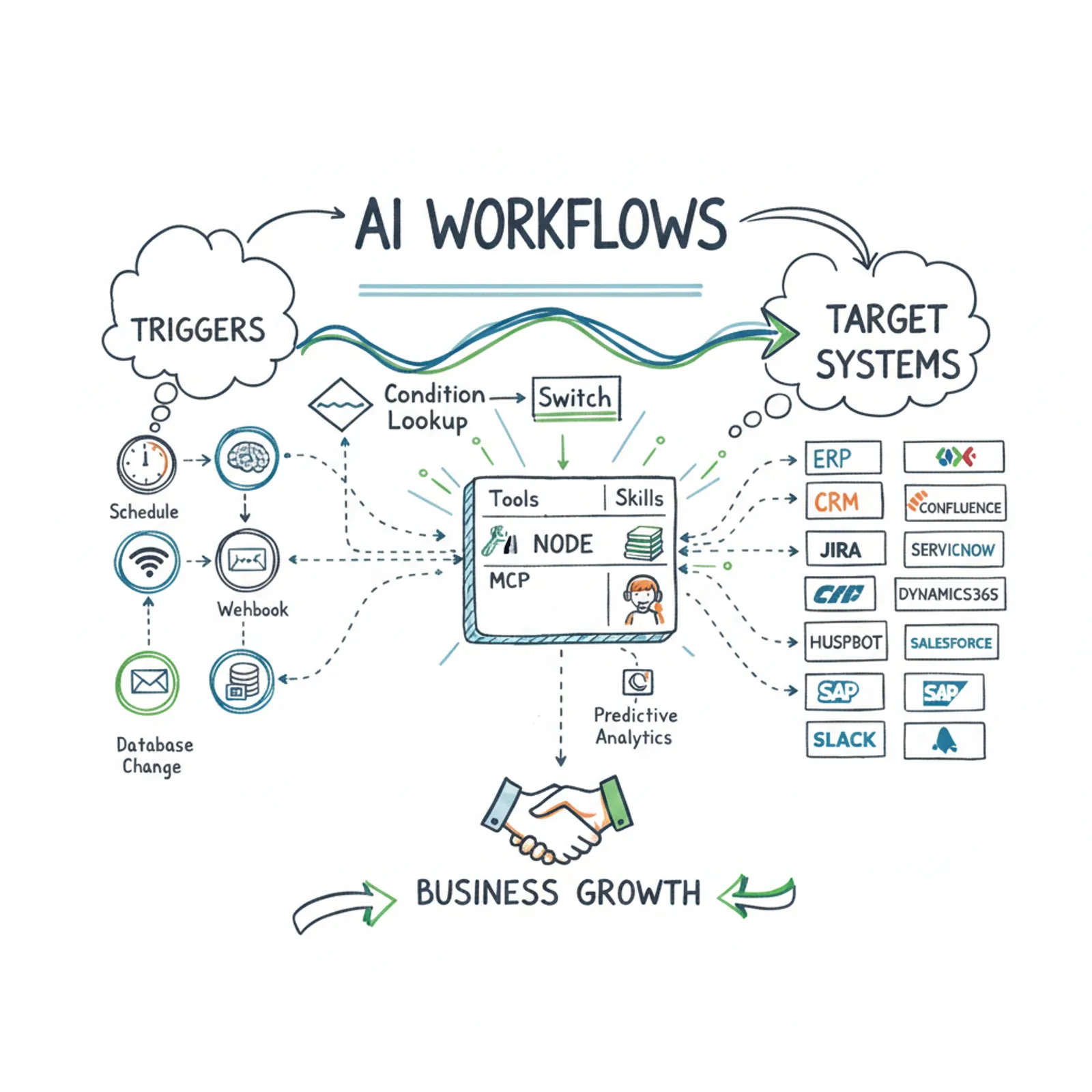
Works with your existing systems
The AI workflow connects your existing software – no need to switch systems
CRM
Salesforce, Microsoft Dynamics, HubSpot – customer data and service history always up to date
Communication channels
Teams, Slack, email – automatic status updates to the right people
Ticketing systems
Jira, ServiceNow, Freshdesk – tickets are created and updated automatically
Documentation
Confluence, SharePoint – incident reports and lessons-learned documents are generated automatically
ERP and logistics
SAP, NetSuite – spare parts status, orders, and field service management from a single point
AI workflow in practice
Concrete business benefits
What changes when incident management is automated?
From minutes to seconds
Response time drops by an average of 80%. The first action starts in seconds, not minutes.
Customer knows what's happening
Automatic updates eliminate uncertainty. The customer gets a status update before they even call.
Experts do the right things
Routine data gathering and logging work disappears. Specialists focus on fixing the issue.
Consistent data quality
All systems update simultaneously. No more missing information or forgotten entries.
Scales without extra resources
A tenfold increase in incident volume requires zero additional hires – AI handles the groundwork.
Fast payback
Typically within 1–3 months the investment pays for itself through reduced downtime and increased efficiency.
Want to see how this would work for you?
Book a free 30-minute assessment – let's explore together where AI automation would bring you the most value